Buy 'Hands' - my new recording with Dave Binney, Tom Rainey, and Chris Guilfoyle!

Showing posts with label touring. Show all posts

Wednesday, January 20, 2016

Bangalore


T.A.S. Mani and R.A. Ramamani

Recently I went to to India, to Bangalore, or Bengaluru as it's now officially known, to visit two great friends and mentors - T.A.S. Mani and R.A. Ramamani, the directors of the renowned Karnataka College of Percussion (KCP), an institute that in 2015 celebrated the 50th anniversary of its founding. KCP had a festival in October to celebrate this event, but unfortunately I couldn't be there for that, so decided to make a visit later in the year in order to say hello to the Manis, see India again and get some more rhythmic inspiration from these two geniuses of the art.

Bangalore is the IT capital of India and in recent years its population has exploded, and on the way into the city from the airport you can see from the advertising hoardings that line the roads that money has flooded into the city, and that one of the big ticket items for all of these newly arrived and relatively wealthy workers is buying a luxury apartment. There are literally dozens of different advertisements for new developments in different parts of the city. Unlike the west where it might be considered bad taste to publicly boast about buying a luxury apartment, here the more luxurious and exclusive it is the more the advertisers shout about it.

'Step into the Big League!', read one, and 'Limitless indulgence for a limited few....' read another, alongside images of swimming pools, golf courses and palm trees - the utopian imagery and wording flaunted on all sides as you drive in from the airport. Of course you can see advertisements for these kinds of developments in nearly every country, but the sheer amount of them in Bangalore speaks of its nouveau riche status and the revolution in the demographics of the population that IT has brought to this city.
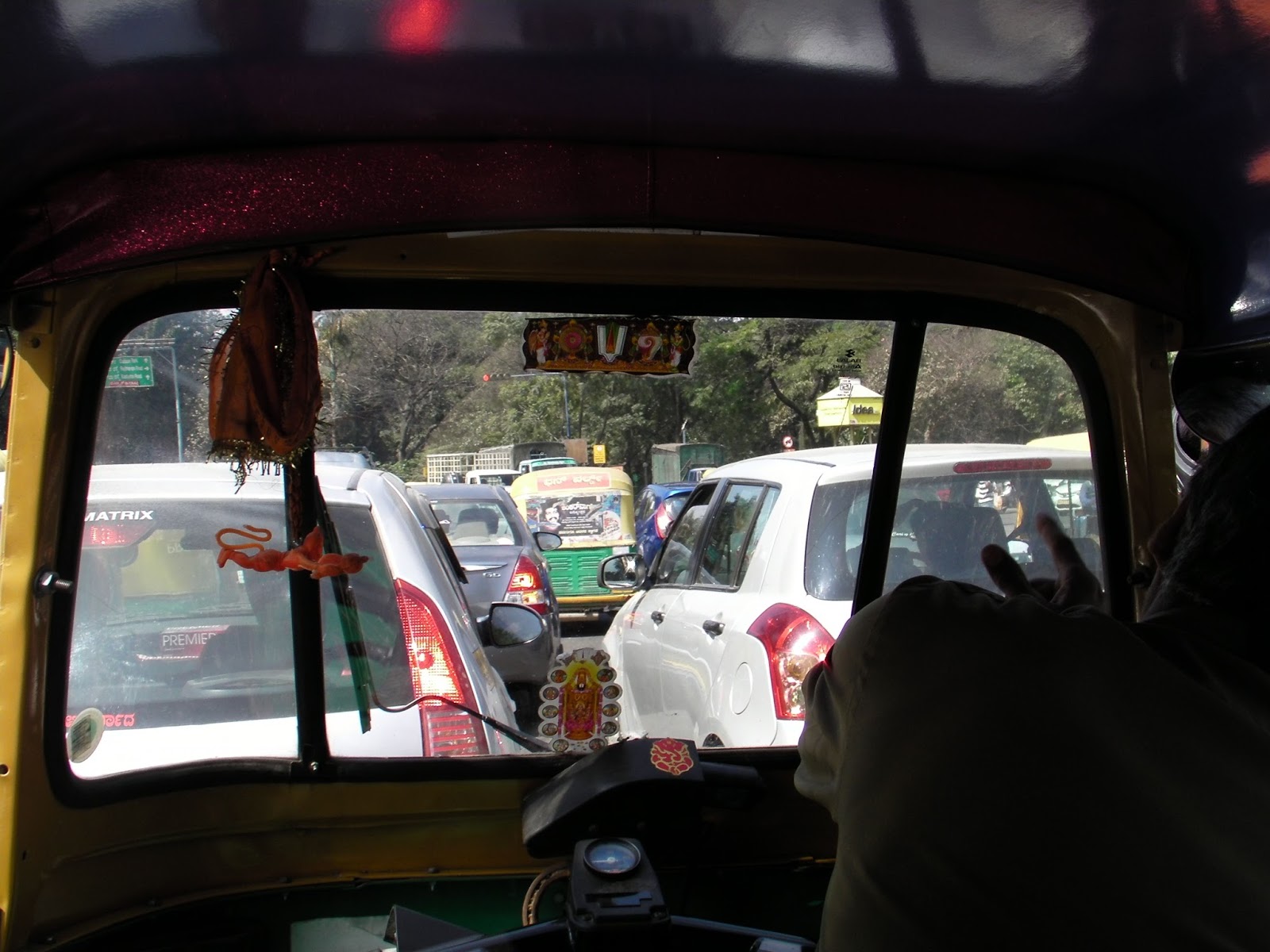

(View from an Auto Rickshaw)

Traffic

One of the inevitable by-products of this new-found wealth is an explosion in traffic levels. Indian cities are famous for the extraordinary and anarchic traffic that chokes all towns of any size. I've been to Bangalore many times before but this time was shocked at just how the traffic levels have risen. The traffic seethes through every street, huge traffic jams build up at junctions and red lights, and are released in a fanfare of blaring horns, roaring engines and vast billowing clouds of pollution. I took this video to give some idea of the traffic levels in the newly-rich city.


Bangalore Moment 1

A motorcyclist gets hit by a 4 x 4 turning left, falls off his bike, wing mirror gets smashed off and knocked a few yards away, a passerby retrieves it and gives it back to him. An interested crowd gather around to watch the free entertainment. 4 x 4 driver looks exasperated by the stupidity of the motorcyclist for being in the way of his car....


(Motorbike and Auto Rickshaw graveyard)

If you read the local newspapers you realise the carnage that is wrought everyday on the roads - particularly on motorcyclists and pedestrians. Hardly surprising since the roads have just too many vehicles on them and most drivers perform the most hair-raising manouevres with no regard for safety or human life - their own or others. Add to that the bizarrely illogical regulation where all motorcycle drivers must wear a helmet, but pilion passengers do not, and you have a recipe for the huge loss of life that occurs literally every day. One story in the paper described how a motocyclist was killed when he struck an earthmover which was being driven at speed the wrong way down the road in the dark, without lights. Another told of how a student was crushed under the wheels of a bus when two buses raced each other to try and take the same parking slot. Every day in the papers there were reports of at least three separate fatal road accidents - you take your life in your hands every time you go out into traffic in anything other than a car.

Having said that, taking an Auto Rickshaw ride is a truly authentic Indian experience. You really get a close up of the way Indian traffic works when you're twisting and turning in between all kinds of vehicles, squeezing through impossibly small spaces, narrowly avoiding all kinds of obstacles, breathing in great lung-fulls of motor fumes, being deafened by car horns and unashamedly stared at by all-comers whenever you stop at traffic lights. It's definitely not for the fainthearted and I tend to be quite fatalistic whenever I take one of these rides - in the right frame of mind they can be quite exhilarating as you zip through the traffic maze, but they can also be experiences where your heart is in your mouth, and you breathe a sigh of relief, (and exhale quite a lot of polluted air while doing so), when you eventually, and gratefully, reach journey's end.

(Hand-painted police warning sign)

One of the things I always do when in India is read the local newspapers. Apart from bringing you up to date on the local political intrigues, they are full of stories that are sometimes hilarious, sometimes baffling, sometimes shocking, and always absorbing. Here are a few of the headlines I saw on this trip:

"Man saves son's life, also takes snake to hospital"

"Ride horses and cut pollution, says Govt Minister"

"Airport bus driver dozes off, rams aircraft" 

"Rookie gang kidnaps realtor's son" 

'Man sets wife on fire for not cooking mutton curry properly

This last headline was a particularly shocking story, and unfortunately does represent one troubling aspect of Indian life - the difficulty for many women in contemporary India. There have been some very high profile cases recently where women were attacked by gangs of men, and which attracted international attention. But reading the papers here one gets a sense that India is a very challenging environment for women, and I saw many heartbreaking stories in the newspapers. But of course one should never generalise about these things and there are many powerful, successful, and resourceful women living and working in India also.


India is always known as a land of contrasts and this can also be seen in the stories in the newspapers. For a country full of friendly, kind, and humorous people, there can sometimes be a level of heartlessness on display, as represented in news stories, in everyday life that is hard to understand. The Times of India reported on an incident in which a flight mechanic was killed when somebody pressed the wrong button on the plane he was working on and he was sucked into the engine. What followed displayed a level of callousness that was extraordinary. Air India, the company for whom the man worked, phoned one of the neighbours of the man's family, and told them, since it would be better if the news came from the neighbours,  to tell the man's wife that her husband had had a 'minor accident'. The logic and heartlessness of that action beggars belief....

On the other hand there are stories of ordinary people going out of their way, and sometimes risking their lives, to help other people. As  a stranger if you ask for help on the street, everyone will do their best to help you, and you are treated in the most generous way. So the contrast of these two facets of Indian life, the kindness and helpfulness of ordinary people, and the callousness of large organisations and of people in power, is very striking.

Bangalore Moment 2

Eating Tandoori chicken outdoors - in a blur of black feathers,  a crow swoops down, snatches a portion and flies off .....


How I spent Christmas Eve.....


On one of my first visits to the Manis on this trip they asked me would I be willing to give a talk on jazz and Carnatic music, the differences, the similarities, how to make them work together etc. I was delighted to do it since it's the sort of thing I'm really interested in and the evangelist streak in me loves to both talk to jazz musicians about Carnatic music, and in this instance, to Indian musicians about jazz!

The event was co-hosted with the KCP by another school, The World Music Conservatory, a wonderful place run by Sangeetha Srikishen, great lady who is very passionate about music and education, and who has created a fantastic school, (with a mango tree at its centre!), where kids can study music, and painting, and the creative arts in general.


A very nice audience of both young people and more mature students assembled and I talked for about two hours on various subjects. I particularly focussed on the African-American rhythmic tradition, not just in jazz but in other related musics, and tried to give a sense of how that differed to South Indian rhythmic practices, and also what the similarities are. It's a fascinating area, for me too, and having to give the talk made me think a lot about these two great rhythmic traditions and the relationship, if any, between them. 


(Corridor of  World Music Conservatory)

To take a broad view, the biggest rhythmic difference between these two traditions is that Carnatic music takes a linear approach to rhythm, with very complex compositional structures, requiring very accurate subdivisions in order to make everything work. Metric modulation plays a very big part in their music, (though they don't call it that, but rather 'first speed, second speed, third speed' etc.). African-American tradition on the other hand is more multi-layered, with the widespread use of the 3:2 polyrhythm as a basis for collective improvisation and groove making. Carnatic music, as complex as it is, doesn't use polyrhythm as an improvisational device, and jazz in general does not use pre-ordained complex rhythmic compositional structures as part of the improvisational fabric. Another big difference is that a lot of jazz (and other western music) structures are grouped in multiples of two, four, eight-bar form etc. This is not the case in Indian music where the requirements of the time cycle and compositions overlaid on them are the generators of form.

The audience were wonderful and stuck with me as I went through the various historical and structural aspects of African-American rhythmic traditions, and I also told of my own history with Indian music, how I came to it, how I learned to understand it better, and how I used it in several compositions and projects. It was a really great way to spend Christmas Eve, one of the best Christmas Eve experiences I've ever had! 

Bangalore Moment 3

We are stuck in traffic in an Auto Rickshaw, a Hijra is working the traffic, not so much begging as demanding money. Our driver pretends not to notice the Hijra, but  for that he receives a rough slap across the shoulder, and a look of utter disdain - he reaches into his pocket takes out some money, hands it over and we drive off......

Marriage

Another fascinating read for the interested visitor are the ads in the matrimonial section of the newspaper. It seems that parents place the ads and they're quite consistent in what they describe, both in their offspring and the desirable attributes of a mate for said offspring. Generally the boy will be described as handsome, and an IT or engineering graduate with a good job. The parents will often describe themselves in glowing terms ('doctors', 'high status'). The desired girl will be described as having to be beautiful, (or 'B'ful'  - to save money on the letter count...), from a business family, and, sometimes, 'non-working'. Often the advertisers are so broadminded that they don't worry too much what caste the girl is! 


Another apparently desirable attribute in a bride, that one often sees described in these ads, is being 'fair'.  India is very conscious of skin colour, and the darker you are the less chance you will have of being seen in advertisements, magazines, movies etc. Looking at the models - male and female - in the ads in India, they are so fair skinned that one could be forgiven for assuming they are from Spain or Italy.  People of darker skin are pretty much ostracised from visual advertising of all kinds. To be 'fair' is also a desirable trait in a prospective bride it would seem.

The Manis and The KCP

(With the Manis in their home in Bangalore)

The main purpose of my visit was to visit my very good friends, masters of Carnatic music,  and rhythmic mentors, T.A.S. MANI and R.A. Ramamani, and their legendary school the Karnataka College of Percussion. This year they celebrated fifty years since the foundation of the school by Mr. Mani. It's worth noting what an amazing thing it was to create a school in those days. Mr Mani is trained at the highest level of the traditional way of learning in Indian classical music - the guru system. Traditionally, to learn this music you had to study relentlessly over many years with your guru, and he or she would themselves be a respected performer at the highest level, who may or may not take you on as a student or, more tellingly, a 'disciple'. Even though he was a brilliant product of this system himself, Mr Mani had the vision to decide that there could be a different way to impart the knowledge of this great music, and one that could be more inclusive and allow the knowledge to be spread to a wider number of people - by opening a school.

The result of this foresight and innovation, was the creation of a school that has become an institution around the world, that has attracted many great internationally renowned musicians such as Charlie Mariano and Steve Coleman. I've written previously about the KCP, Mr. Mani and Ramamani, and their work with jazz musicians - you can see it here.  Ramamani has herself created a wonderful body of work that simplifies the complex Carnatic structures to make them more accessible to jazz musicians and allow cross-genre collaboration more easily. 

But on this visit to Bangalore, I was once again bowled over by the work they do in spreading the knowledge of Carnatic music among people of all ages and backgrounds. It is a truly egalitarian artistic project that they have been developing for fifty years, an extraordinary achievement. I took the opportunity to learn some new Mukhtais (complex rhythmic compositions), from Mr. Mani and here he is showing me one of them.


But not only do they teach visiting international musicians and amateurs and professionals from their own country, they also teach children these fantastic techniques, both in percussion and in singing. To give an example of the incredible work they do and the extraordinary talent and accomplishment of some of their young students, here's an edited clip of some of the lessons I witnessed -  Ramamani teaching an 11 year old singer, and Mr. Mani teaching Konnekol to an aspirant percussionist, also aged 11.


Everything that can be said about India has already been said, usually by people far more eloquent than I. This was my seventh time in the Subcontinent and for me it remains as unique, wonderful, challenging, and creative as the first time I came here. Bangalore had changed somewhat with the big influx of people and money and the strains on the infrastructure that this has brought. But one thing that hasn't changed is the generosity and brilliance of the Manis and the wonderful way they help to preserve Carnatic music's deep tradition by sharing it with anyone who is interested, and by giving access to information that was hitherto only for the chosen few. Here's to India and the next fifty years of the Karnataka College of Percussion!


Wednesday, January 22, 2014

Recording in New York


New York is always great if you’re a visiting jazz musician. The sheer concentration of high level musicians there is unequalled anywhere else in the world. I’m not sure how many times I’ve been to NY – must be approaching twenty times at this stage – and I’ve been there in many capacities, as a tourist, as a teacher, and as a performer, but this was my first time there to make a recording. Earlier this year I decided that it was about time I recorded a new album - my last one (Renaissance Man with John Abercrombie), though only released last year, was in fact recorded in 2008. Such are the vagaries of the recording business these days that it took four years to get it out.... 

So it was definitely time to record again, and as I thought about it, I came to the realisation that I'd like to record it in New York, and do it with some musicians who were a) great, and b) with whom I had a history. Quite often musicians go to NY to make Allstar-type albums, and many times the results are unedifying since there's almost no rapport between the leader and his or her sidemen. In these situations there's often a 'guns for hire' feeling from the NY musicians - of course they play great, but they're there because they've been hired and since it's not a working band, they don't really have an investment in the result. I didn't want that, so I asked two musicians with whom I'd played in the past - Tom Rainey and Dave Binney - to record with me, and my son Chris, who's an up and coming guitarist in his own right and who (for obvious reasons), also knows my music and whom I knew would put the work into learning the sometimes difficult pieces.

So early in January Chris and I took off for NY - I decided to go a few days earlier in order to be able to see some music, and to ensure that jetlag would play no part in the recording process. If you travel that far and at quite an expense, the last thing you want is to be sleepy during the recording! We arrived on the coldest New York day for months, just missing a snowstorm and arriving from a relatively balmy 8 degrees in Dublin to a frigid -10 or so in New York. I'd seen the forecast so I had brought the right gear for the weather, but it's always a shock to step into that kind of icy wind, one of a kind we don't ever get in Ireland. More cold weather was forecast for the week that we were there, but I think the media really hype up the approach of bad weather - there was quite a bit of hysteria around the idea of the 'polar vortex' that was apparently going to strip the skin off our faces if we went out for more than five seconds. It reminded me of the great send up of this kind of media-induced panic from the Simpsons….


Our (perfect) host while we were in New York was the wonderful bassist and all-round great guy Arthur Kell who has a fantastic house in Bedford Stuyvesant in Brooklyn, complete with much of the original 19th Century woodwork intact - in a city where space is at a premium, Arthur's house is spacious and full of character and we were very lucky to be able to be able to base ourselves there for the duration. Shortly after we arrived we were also lucky to be able to see a fine concert by Arthur's quartet at Matt Garrison's very nice venue Shapeshifter Lab in Brooklyn. This was my first time visiting this venue, and I was very impressed - it has good sight lines and, from where I was sitting, the sound was very clear.


(Arthur Kell's Quartet, playing at Shapeshifter Lab)

Arthur's music is quite unique, complex at times yet always tuneful, and with some really nice hooks to the pieces. It's very hard to put your finger on what the music sounds like in terms of being able to compare it to one modern jazz genre or another, it really is very characterful music with a sound of its own. For this gig the guitarist Nate Radley subbed for the altoist Loren Stillman and did an incredible job on virtually sight reading the music - more evidence of the kind of high craft skills you find in New York. I'd heard some of this music before, but it was very interesting to hear it with two guitars, (the other musicians, apart from Arthur on bass, were Brad Shepik on guitar and Mark Ferber on drums), it gave it a very different and attractive sound. At the end of the gig I ran into Matt Garrison which was really a pleasure - I hadn't seen him since 1993 when he was a student at the IASJ meeting in Siena in Italy, so it was nice to see him again. Of course apart from running this great venue he is also an incredible bassist……

Sunday also gave me a chance to meet with and catch up with the guitarist and arranger Dave O Rourke, an Irish jazz export to NY, and someone I've known since we both met queuing up to see Louis Stewart play in the late 70s in Dublin. Dave runs the fantastic Jazz Standard Jazz Discovery Program at the club of the same name, a development program me for youngsters in New York which both gives them an educational element and an opportunity to play in one of NY's finest clubs. As always it was great to meet up with Dave and talk about the past, present and future of what's been going on with us since we last met. Dave's made a serious career for himself in NY, as an arranger and composer, and is without doubt one of the most generous people I've ever met in the business. Dublin's loss was NY's gain….


(Left to right - Lindsey Horner, RG, David Gage, Chris)

The following day was a busy one - beginning with a trip to Brooklyn to have a session with Matt Jacobson - an Irish drummer livening in NY for a year on a Fullbright Scholarship - and some other young musicians. We just got together and played through some tunes and some open improvising. It was an effective way to loosen up and reconnect to the instrument again in preparation for the recording, and all the young guys sounded really good.

Then we were off into midtown Manhattan to meet one of my oldest musical friends Lindsey Horner, and visit the very legendary bass shop owned by David Gage. If there is an acoustic bass Mecca anywhere, then this is it - the signed photographs on the wall alone are testimony to the fact that this is the the place to come and buy a bass, or have a bass repaired, or just to chew the fat and see what's happening in the bass world. The shop has a great vibe - a sense of professional pride in their work is in the air, and you get a feeling of old-school craftsmanship from meeting the people who work there, and from watching them at work. I'd never met David before, but Lindsey introduced us and he very kindly gave us a tour of the building, which is being refurbished upstairs and is deceptively big. Floor after floor of basses….. it doesn't get much better than this if you're a bassist, and we even were invited onto the roof, which had a spectacular view, and from which the photo at the top of this piece was taken.

Then it was back to Brooklyn to meet my brother Dara, who's been living and working as a Drum and Bass DJ in New York for almost twenty years. We met him and his partner Meredith, and again had fun catching up, at a great Turkish restaurant  where I ate not wisely, but too well…. it's always a dangerous thing to eat so much food when slightly jet-lagged, especially when you know that you've still someplace to go - and we really had somewhere special to go - the Village Vanguard to see the Vanguard Jazz Orchestra.


The VJO is truly the Rolls Royce of jazz orchestras. Their combination of a tradition stretching back to 1964, the opportunity to play every Monday night over such a long period, having the best writers composing for them (Thad Jones, Bob Brookmeyer, Jim McNeely), and having a band bristling with great soloists and players has made them into the extraordinary unit they are today. I usually try and see them whenever I'm in NY, and on this occasion they were at the top of their form. The set contained an extraordinary long form piece by Bob Brookmeyer, followed by two signature McNeely pieces, and all this bookended by two great swinging Thad pieces. Hearing this music, played so brilliantly by this band, in the most famous jazz club in the world, is what makes New York special for anyone who loves jazz and its traditions.

Rehearsal 

The following day we began the serious work - the reason we came here in the first place, to record the music. But before going into the studio, I'd booked some rehearsal time at Michiko Studios, a favorite professional rehearsal space for New York jazz musicians. That become clear in that while only there for a few hours, I ran into Mark Helias and Nasheet Waits (great guys both - Mark told me he'd got an Irish passport since I'd seen him last!), and saw Lennie White crossing the lobby.

We had four hours to get through seven pieces of varying degrees of complexity - both Chris and I knew the music, and Tom and Dave are both incredibly quick and skillful, so it doesn't take them long to learn new music. In the time that had elapsed since I released 'Renaissance Man', I had written quite a bit of new music, and as someone who composes a lot, I had many compositions which had never been recorded before, so I wasn't short of material. I'd selected pieces that I thought would work for the instrumentation and and the players, and had written two new pieces that I felt would fit well in the overall shape of the recording. It was clear as we went through the pieces that most would go down with little trouble, and a couple of pieces would require a fair bit of work. At the end of the session I was happy that we'd knocked some of the rough corners off the pieces, familiarized ourselves with the shape of them, and made great strides towards ensuring a fruitful two days in the studio.

That evening we went to see Dave's quartet at the 55 Bar - the club he's made into a regular spot for his bands and music. I envy him the luxury of having a place like this to play on a regular basis - this is still the only way you can properly develop music. Dave's quartet, which on this occasion featured John Escreet (piano), Eivind Opsvik (bass, and subbing at the last minute for an indisposed Dan Weiss, Nate Wood on drums. Dave has definitely done that most difficult of things - developed a group sound, and it was a pleasure to hear a working band tear through original material like that. The fact that Nate Wood could play the music so well despite subbing at the last minute, was yet again a testimony to the wealth of talent in New York.


In the Studio

So, at last we got to the studio, the legendary Systems Two in Brooklyn. Incredibly well run by Nancy, Joe and Mike Marciano, this studio is one of the best jazz studios in the world. I say 'jazz studio' because it is set up and run with a complete understanding of the requirements for jazz musicians, and the people who have recorded there read like a who's who of contemporary American jazz. When you record there you can see why it has the reputation it has. I first went there in the mid 90s, recording with Steve Coleman, and was knocked out by how quickly they got a great sound and how easy the whole environment was to work in. Recording is not easy - it's such a different environment to live playing, and sometimes it's hard to get a natural atmosphere going and overcome the potential sterility of the studio.

The difficulty of getting a natural atmosphere can be compounded by poor studio equipment and slowness of the studio engineer and technicians. There's nothing more counterproductive to creative playing than hanging around for ages waiting to get a decent sound or for the engineer to set up the mics. In Systems Two this never happens, and when we arrived everything was set up - music stands, headphones, personal headphone mixer (a HUGE timesaver!), mics, guitar stands - and though there were isolation booths around the saxophone and drums, there were great sight lines everywhere and everyone could see each other, and get a good sound on the headphones.

In the first day we recorded four of the seven pieces, two of which went down very easily and two of which required more work. Again we were helped in our work by the great sound in the studio, and the speed that our engineer Max was able to organise things in the control booth and get a great natural sound for playback purposes. In recording, there are a lot of balancing acts going on - how many takes do you make? Will you get a better take if you do another, or will it get stale? How finicky do you have to be about getting things technically perfect, versus allowing things to sound natural despite the odd glitch here and there? What needs to be fixed in the studio, or what can be fixed afterwards in the editing? All of these things need to be balanced, and there's nothing that helps you more in making your decisions than experience. Even then you can sometimes get it wrong.


(The setup for our session at Systems Two)

But I was very happy with the first day's work, and with such great musicians I always knew that we'd get a good result.

Next day it was back to the studio, and we finished the recording, the very last note being logged at exactly 4pm - the designated finishing time for the session. The big piece on this day was 'Hands', the first movement of my guitar concerto, built on a riff that I love, and here adapted for the quartet. There are quite a lot of tricky passages to be negotiated on this piece, but eventually negotiate them we did - which was a relief, because prior to the session I wasn't sure if it would work in this format or not, but I was very pleased with the final result.


And I was very pleased with the final result of this trip to New York - thanks Dave, Chris and Tom!

I've written before concerning the amount of musicians in New York, and it being a double-edged sword, but it's always great to visit and it's certainly great to have the chance to record there with such great musicians. So much incredible music has been recorded there over the years and it was nice to be even a tiny part of that history.

If you'd like to see some more photos from the session, click HERE

And in case you're interested in getting a taste of what we recorded, HERE are a few short clips of some of the pieces we did - the CD should be out later this year - watch this space!


Saturday, November 3, 2012

On The Road with Pekka - Part 1, Europe


In October and November of this year I took part in a two-legged tour with the great Finnish alto player Pekka Pylkkanen and as part of his Global Unit group. The first part of the tour took place in France and Switzerland, the second leg in Japan. I've played in this group in the past and it's always fun, being made up of great musicians from different parts of the world (hence the name). For the European leg the other musicians, apart from Pekka and myself, were the American pianist Greg Burk and the Brazilian drummer Carlos Ezequiel. Both wonderful musicians, I've played with them both before in Pekka's group, and with Carlos in several other configurations, including a memorable trip to India earlier this year.

My trip began as so many do, with having to get up at 4am (bleh.....) to catch the red-eye to Geneva, and from there to Basel where we were playing two nights at a wonderful club, The Bird's Eye. We were also going to do some live recording, some recording during the day, and combine that with a studio recording at the end of the week in France. A lot of people don't realise what musicians have to do on the road sometimes - in this case, we had four musicians who have come from four different countries, travelled long distances, went straight into rehearsal, put two sets of music together in 90 minutes, soundchecked, ate quickly and then played two sets of music. And some people think being on the road is glamorous!


Considering how little time we had and how tired he were, we played some very good music - a mixture of originals by Pekka, Carlos, Greg and I, and a few arrangements of jazz standards. But the extremely long day kicked in, and I definitely hit the wall half way through the second set - got totally exhausted and had to dig deep to keep my concentration and play competently at least for the last few tunes.

But a good night's rest will do wonders, and the next night was much better - the band sounded better and we were starting to get a real grip on the music. The result of getting to know your material in jazz is always one of creating a feeling of both tightness and looseness - tightness in that the written and composed material is played better, and looseness in the sense of a feeling of freedom within the material that comes from having confidence in knowing that material well. We got into some good energy and the audience responded warmly - it all boded well for the next day's recording.

And the recording the next day was indeed a good one - it was nice to record on stage rather than in the often sterile environment of the studio. And since we'd played the music the previous two nights we had the cushion of both being comfortable with the material and the recording environment, which is a real bonus. We recorded pretty much all our material and then recorded a bunch of improvised short vignettes - pieces improvised on the spot, each one started by a different member of the band. I've always liked doing this - these pieces can often reveal aspects of the band that are not evident in the written material. I haven't listened back to the material yet, but I'm looking forward to hearing these pieces - I think we did some really nice ones!

Recording finished, we headed to Basel airport (which must be the only airport in the world that straddles the border of two countries......), hired a car and drove into France. We headed for Metz to stay overnight, and on the drive there got into some lengthy discussions of politics and economics and the current political/financial situation. Jazz musicians should really record these on-the-road conversations - on this trip we pretty much solved all the world's problems - who needs politicians and economists when you have a jazz quartet to sort everything out!?

(Metz Cathedral)

We had some time off the next morning before heading to Fontainebleu, so Greg and I took a look around Metz, an interesting town that shows both German and French influences. The Cathedral is renowned and when you step inside you can see why - it's a vast Gothic construct with a soaring ceiling and featuring beautiful stained glass windows by Chagall. The size of it and the fact that people have prayed there since the 5th Century gives even an atheist like me an idea of the power religion has had on the minds of people over the centuries.

And the power that good food has on me in France should not be underestimated either - having basked in the glory of Medieval religion, it was time for Greg and I to bask in the glory of local French food, at a local market and to eat a simple but great lunch at a famous soup counter in the market, beside the cathedral. I partook in the delicacy of Boudin Noir with apples (an acquired taste perhaps, but one I acquired a long time ago, raised as I was on Black Pudding - the irish equivalent), while Greg had some fantastic slow-baked lamb. French food is often thought of as fancy and chef-y, but regional French food tends to be both simple and delicious.

And the food theme continued as we headed off for Fontainebleu to play the next gig - at a jazz club that is owned by and is an annexe to a Moroccan restaurant. The R-Jazz Club is a cosy little club and the owner and his family are lovely people - genuine enthusiasts who love the music and their club. It was really a pleasure to play for them, and also a pleasure to eat the wonderful food they provided for us before and after the gig - all jazz club gigs should be like this!

(Gourmet Market - Milly La-Foret)

We stayed the night at a small hotel in the nearby town of Milly La-Foret, a small quiet place that sports a gourmet market (more food!) on Saturday mornings. All kinds of artisan products were on display and the market demonstrated again the importance the French place on food - if only all countries were the same in this regard.......

And then it was off to another small town - Dammarie-Lès-Lys


 (Pekka and Carlos at the studio)


We were recording in a studio in the engineer’s home – I like these kinds of environments, again they’re a bit different to the airless bunkers that often constitute studios these days. The engineer’s house was in a small town in the countryside and the whole scene was pleasant and conducive to relaxed but concentrated work. Where else but France could you take a break and have a lunch of Confit Duck in a local restaurant? We got all the tracks recorded that we hadn’t managed to get to in Basel, and we re-recorded a couple of others, and then we headed for Dammarie-Lès-Lys where we would be staying for the next few nights.


Dammerie is close to Paris, and we had a day off the next day so it was a foregone conclusion that we would head into town at some point. And what a perfect day for a trip to Paris it was! A beautiful late Autumn day, bright sunshine – it was almost like being on the film set of one of those Hymn-to-Paris movies that Woody Allen makes. Carlos and Greg went in earlier and went around the Louvre, (Carlos commented that his smile is more mysterious than that of La Giaconda – see below and decide for yourself….), Pekka and I headed in during the late afternoon and we met up with the guys, walked around in the sunshine along the Seine, and had a delicious and very good value dinner in a great traditional Bistro, before heading back to our hotel in Dammarie. Sometimes being a musician IS glamorous! Or at least lots of fun………

(Carlos enters a smiling competition with the Mona Lisa)


The reason we were in Dammerie was because of its proximity to CMDL – the school of Didier Lockwood, where we did a combined workshop and concert performance. The school is in a lovely setting and has a student body of around 100, which is a perfect size in my opinion – big enough to be interesting, but not too big to become impersonal. I got together with the bassists, and we discussed various bass related issues, but also musical issues in the wider sense. When you get together with a group of students whom you haven’t met before, and you only have an hour, it’s hard to get into much concrete information, since by the time you know what it is they wish to work on with you, the time is almost up. But they were a very receptive group, we managed to get into some interesting stuff, and a good time was had by all.


After the workshop we played a concert for the students for about an hour – really fun, because at this point we really knew the music and were able to get into it immediately and explore it more fully at the same time. This was our last gig on this leg of the tour, so it had the usual bittersweet flavor that these last gigs on tours always have.

To give you an idea of some of the music we played, here's a recording of a piece of mine called 'Traditional', recorded live at the Bird's Eye club on the second night of the tour.


(Greg, Pekka, Carlos and I, outside the Bird's Eye Club in Basel)

 So that was that – some travelling, lots of music, lots of new music recorded, and lots of good food! I left the next morning to go back to Dublin to change my clothes re-pack my bags, and head off for the second leg of the tour – Japan!


Tuesday, April 10, 2012

A Week in India with George and Carlos


An account of our recent trip to Mumbai and Delhi and some thoughts thereon

Being awoken by the Muezzin’s call to prayer at 5.30 am suggests to my sleep-drugged mind that I’m in a different place. Waking up several hours later to see a hawk fly past my window in the hot sunlight confirms it. I’m in Mumbai, for the first time in fifteen years, with my good friends and great musicians George Kontrafouris and Carlos Ezequiel. This my sixth time in India, and it’s one of my favourite places on earth – the food, the people, the colour, the intensity, the sheer difference of it, make it an extraordinary place to visit, and I’m always glad to be back.

Apart from anything else, India always affords one the kind of good natured, yet baffling conversations that a seemingly simple request can generate. Like this morning when I went into the hotel coffee shop to get a coffee and something sweet.

Waiter: Good morning sir

Me: Good morning – could I have a coffee and something sweet – anything.

Waiter: A coffee sir?

Me: Yes, a coffee – and something sweet to go with it

Waiter: A sweet coffee sir?

Me: No, a coffee, and something like a biscuit or a cake or something

Waiter: Ah – a coffee with sugar sir!

Me: No, a coffee and something sweet to go with it

Waiter: Just a moment sir – (consulting a folder) what is your room number?

Me: 405

Waiter: But there is no booking for lunch for 405 sir

Me: I don’t want lunch, just a coffee and something sweet to go with it

Waiter: (With a baffled expression….) Just a moment sir.

He goes off and comes back with three more people, all consult in Hindi while looking at booking folder

2nd Waiter: You want lunch sir?

And off we go again…………

Eventually it gets sorted out and a coffee and some biscuits are produced, but every time I’ve been in India I get involved in these kinds of conversations regarding seemingly simple things, but in which both sided become increasingly baffled.

Having all made long journeys to get here, we take it easy on the first day, rest a lot and then go and see the Gateway of India, Mumbai’s famous monument and tourist trap, braving the touts, admiring the sea view and watching the throngs of happy Indians enjoying their Sunday off. The day finishes satisfactorily with a visit to a renowned North Indian restaurant for expensive, (by Indian standards), but delicious food.


The next day’s plan to head out on a trio excursion is stymied by George being sick. Not very sick but sick enough to make him a non-starter for the trip so Carlos and I go on a truncated version, starting with the extraordinary Mumbai Railway Station, built by the British and showing every sign of Victorian confidence in Queen and Empire. It’s a large building, and inside, a fascinating throng move endlessly through the station, each person intent on their own mission, but the whole looking like some giant organism, eddying and flowing to and fro. All main railways stations are hives of activity, but Indian ones are even more so – India Rail employs 1.3 million employees making them the one of the largest employers of human beings in the world. Whole support systems spring up around the stations, including families who live there. It’s an extraordinary scene – chaotic yet ordered.

To walk around the city is to be reminded again and again that the words ‘health and safety’ do not mean much to Indian society at large. Walking out on the street you can witness dozens of acts of hair-raising recklessness within minutes. Cars make U-turns with no warning, bicycles dash between buses and trucks, pedestrians walk straight into oncoming traffic, pillion passengers on motor scooters carry huge unsafe loads, families of 5 squeeze onto a Honda 50, people in cars balance two children on their knees in the front seat. To witness street life in Mumbai, (or pretty much any Indian city) is to watch a seething maelstrom of potential accidents.

And accidents DO happen – all the time. Yet the newspapers seem much more interested in the antics of teenagers, and the machinations of the Pakistanis than they do on the everyday carnage on the streets. For example, while I was in Mumbai the papers were full of an incident in which 6 teenagers crashed their car and one was killed. There followed four days of newspaper articles, much hand-wringing over the state of the nation’s youth, police promises to crackdown on bars selling alcohol etc. – yet in the same newspaper there was an article about the railways in which it was casually mentioned that 195 people had been killed on Mumbai’s railway network in January and February. 195 people killed in 8 weeks! That’s three per day…….


Over 1500 people were killed on Mumbai’s railways last year (mostly run over on the tracks), and yet the media were much more interested in this one car crash in which one person had been killed. Why? Probably because most of the people who died on the railways were poor and the teenagers were from the burgeoning middle class. But any society that accepts that level of carnage on its rail networks is one in which the idea of personal safety is not a priority.

I must admit that on one level I enjoy the madness on the streets – it’s street theatre writ large, you can stand on any street corner and see something amazing, startling and visibly arresting at any time. On the other hand there’s no doubt that this chaotic panorama that give Indian cities their unique visual impact, does come at a great cost to many people.

Carlos and I leave the railway station, take a wrong turn and instead of gazing at Mumbai’s Victorian architectural heritage, end up instead in a seething street market in Mohammed Ali Road, a Muslim area of the city. Although it presents us with another amazing tableau of Indian city life, the cacophony of car horns, dust, 35 degree heat, and sheer press of humanity drives us to seek air-conditioned shelter in a local restaurant where I have a refreshing dish of Khir (cold rice pudding), washed down with a Coke. We then take a taxi down to the Victorian section of the city, have a look around have a brief lunch and head back to the hotel. Fortunately George has now recovered and we eat in an excellent Hyderabadi restaurant attached to the hotel. Hyderabadi food should be much better known in the west than it is. In Europe and the US Indian restaurants are dominated by the same North Indian staples, which though good, don’t come close to representing the culinary diversity of India. Hyderabadi food is rich, but generally spicier than North Indian food, and with all kinds of different dishes which were developed during the Nizam period.

The next day, after a morning trip to Chowpatty Beach, we undertake the first performance at the Blue Frog. The Blue Frog is a very modern club that is breaking new musical ground in India – it’s very well equipped and has a lot of western music - mostly various offshoots of modern pop music, hip-hop, electronica etc. – 7 nights a week. Emmanuelle, the artistic director, once worked in Dublin for the Improvised Music Company, and I’d used that contact to make the initial connection. Emmanuelle made it clear to me at the beginning of our discussions that there was no point in playing acoustic jazz for a quiet listening audience there, since this audience didn’t really exist in India. So we arranged a programme of more funk oriented music which was still fun to play, but which we hoped would appeal more to local tastes.


(The Blue Frog, Mumbai)

The gear was fine, though Carlos had to re-skin the drums, and the sound guys were very good – they got a good sound very quickly, if only all sound engineers were like that……..


So, decent gear, good sound, appropriate music everything was set for a fun gig that night, but…………. Unfortunately the audience was terrible! There was a decent crowd of people in, but they had absolutely no interest in the music whatsoever, treated the whole event as a social evening, played with their iPhones, talked incessantly and some even stood with their backs to us. Each piece was greeted with lukewarm applause, some people seemed startled by the applause, and looked over their shoulders to see what was being applauded, as if surprised that the music wasn’t just coming from a hi-fi system.

I hadn’t expected much in the way of audience appreciation – I know jazz is an unknown quantity in India – but I must admit to feeling irritated by the audience. They’d paid a lot of money by Indian standards to come into the gig and no doubt felt they were cool and hip people by virtue of being in a place like the Blue Frog, but in the end their complete lack of appreciation for the music belied their self-bestowed hipness. I’m not saying that anyone who doesn’t like our music is unhip per se, but what bothered me wasn’t that they didn’t like the music, it was because they clearly had no interest in ANY music – it fulfilled that dreaded ‘lifestyle’ category, along with the iPhones and designer sunglasses and designer clothes. Anybody could have been up there on the stage – good or bad they would have all got the same reaction, whether they played well or not.

But we had fun playing for ourselves at least, and the Blue Frog people looked after us very well and that’s always nice. The next morning we set off for Delhi, for the second gig.


(At the Blue Frog, Delhi)

Delhi’s traffic seems almost worse than Mumbai’s , hard though that is to believe, and the hotel was on the edge of a busy road with traffic roaring past. But the hotel itself was very nice, rooms were great and the food in it was great. I really thought we’d found a gem of a place and made a mental note of it for future reference and trips to Delhi. I was later to be sadly disillusioned about the place, but for now we were very happy to be there.

Off to soundcheck at the Delhi branch of the Blue Frog, and it’s a similar looking place, with again very good equipment and nice and efficient people running the place. Carlos did a bit of surgery on the drums (as in taking the foam padding out of the bass drum so he could get a sound out of it), George figured out the idiosyncrasies of the keyboard, and I was very happy with a Markbass stack – I’d been using Markbass amps at home and to get one here was a great bonus.

The gig that night was a lot better, there were more musicians there and the audience was far more attentive, and consequently we played better too. We chatted afterwards to several musicians had a post-gig drink and went back to the hotel very satisfied with ourselves.


(George at the Red Fort)

We had a day off the next day and we filled it by paying a visit to the Red Fort – a Moghul Palace, still in great condition – a trip to Chandni Chowk, the extraordinary market in Old Delhi, and finally a visit to the Nizamuddin Dagar, a Sufi shrine.

The Red Fort was impressive, although I always find that once you’ve gaped at the huge and beautiful red sandstone walls, its a bit lifeless , and there’s not a lot more to see. Chandni Chowk on the other hand is bursting with things to see – cycle rickshaw guys carrying impossible loads, hawkers shouting and importuning, food sellers on the side of the street doing a roaring trade in Jallebis and Puris, shops selling everything from Pashminas to rifles, Sikh temples and mosque etc. etc. – all human life is there, and I always go to the Chowk every time I visit Delhi.

Here's a few minutes of footage from the Chowk, to give you a flavour of the scene......


We finish with a visit to the Nizamuddin Dargah, a famous shrine of a Sufi saint where the faithful come to pray and ask the saint to intercede on their behalf. On Thursdays, at sunset, the Qawallis – a group of singers and musicians who sing at these shrines, (the most famous of which would be the late great Nusrat Fateh Ali Khan) – sing their devotional songs beside the tomb of the saint and we were determined to see this. I’d seen Qawalli music before but always in concert halls, never in its proper setting.


(Qawalli Singers at the Nizamuddin Dargah)


The scene was extraordinary – thousands of people, many dressed in colourful garb, from many parts of the Muslim world, all worshipping at the shrine, but also buying food, buying offerings for the saint’s tomb, and surrounding the Qawalls as they sing their devotional songs. There’s a huge crush and constant movement. From a musical point of view (or at least my musical point of view) it’s a disappointment in that the noise of the crowd is so great, I can’t hear the musicians well at all. But although it’s disappointing musically, the scene itself is fantastic – it really felt like a privilege to see it.

Unfortunately the evening was to end on a sour note – I had my pocket picked on the way out and had my wallet taken…….. We were putting on our shoes and there was a small group of boys poking at us and begging, and it was in this melee that they managed to take the wallet. I realized immediately it was gone, but it was too late to do anything about it. We went back to the hotel to cancel my credit cards when we went back to the hotel to cancel the cards etc. the desk clerk wouldn't give me a key card to get back into my room until we paid him 300 rupees as a 'lost card charge'. The fact that I'd been robbed and had no money didn't make any difference to him, so I had to borrow the money just in order to get back into my room. That hotel is very nice, lovely rooms etc. - but I couldn't believe the lack of sympathy and customer service they showed in dealing with this. So beware this hotel – it looks good, but the management are a bunch of grasping sods. The name of the hotel is Saket27.

But although this was a bad way to end the trip, the whole thing was another great Indian adventure. India never lets you down – it’s always spectacular, and extreme, and intriguing, and annoying, and exasperating, and hilarious, and thought-provoking and many more things. This was my 6th time there – can’t wait for the 7th!


(The Last Supper!)